What Programmer Should I Use to Upload Sketch to Esp32 in Arduino Ide
Annotation: This tutorial was written after Arduino has officially launched its support for ESP32 boards. And so if yous take followed the onetime method of using GIT to install the boards then you would have to follow these steps again (highly recommended) if you need support for new libraries. If you are working with ESP32 for kickoff fourth dimension you lot exercise non have to worry about this.
Internet has reached virtually every pocket through smart phones, it is estimated that about iii.2 billion people utilize internet but surprisingly almost viii.4 billion devices utilize internet. That is electronics devices are connected to cyberspace more than twice of the population who use internet and it is making the things around us smarter every day. The major reason is the boom of Internet of things which is commonly known as IOT, it is also estimated that by the end of 2020 we will have 20.4 billion devices connected to the internet. So information technology's time to prepare and rise upward our sleeves to work with IOT projects if we want to go along upward with this development, lucky for the states the open up source platforms like Arduino and Espressif Systems has fabricated things a lot easy for us.
Espressif Systems launched the ESP8266-01 long back which opened doors to many hobbyists to get into the world of IOT, since then the community has been developing strongly and many products has striking the market. Now the launch of ESP32 Espressif has taken things to a new level. This tiny cheap viii$ module is a dual cadre 32-bit CPU with built in Wi-Fi and dual-manner Bluetooth with sufficient amount of 30 I/O pins for all basic electronics projects. All these features are very piece of cake to employ, since it can be programmed directly from the Arduino IDE. Exiting enough... So let's starting time programming ESP32 with Arduino IDE and then you lot tin can endeavor all the interesting IoT based projects using ESP32.
Materials Required:
- ESP32 Module
- Arduino IDE
- Programming cable (micro USB cable)
- The soul rock from MCU (just kidding)
Hardware Data of ESP32:
Permit's have a look the ESP32 module. It is slightly bigger than the ESP8266-01 module and is breadboard friendly since most of the pin headers are broken out every bit I/O pins facing each other which is a peachy matter. Permit'south break the lath into modest parts to know the purpose of each segment
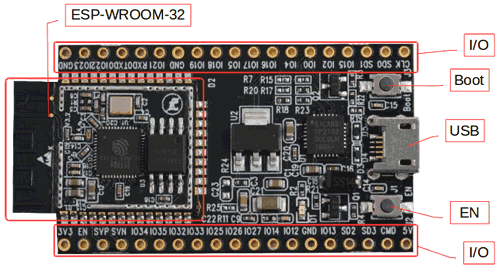
As yous tin see the center of the module is the ESP-WROOM-32 which is a 32-flake microprocessor. It also has a couple of buttons and LEDs which are explained below.
Micro-USB jack: The micro USB jack is used to connect the ESP32 to our computer through a USB cablevision. It is used to program the ESP module as well as can be used for serial debugging as it supports series communication
EN Button: The EN push button is the reset button of the ESP module. Pressing this button will reset the code running on the ESP module
Boot Button: This button is used to upload the Program from Arduino to the ESP module. It has to be pressed subsequently clicking on the upload icon on the Arduino IDE. When the Boot button is pressed forth with the EN push button, ESP enters into firmware uploading manner. Exercise not play with this mode unless you know what you lot are doing.
Red LED: The Red LED on the board is used to indicate the power supply. It glows red when the lath is powered.
Blue LED: The Blue LED on the board is connected to the GPIO pin. It tin can be turned on or off through programming. In some Chinese cloned boards like mine, this led might also exist in ruby colour.
I/O pins: This is where major development has taken identify. Unlike ESP8266, on ESP32 nosotros can admission all the I/O pin of the module through the interruption-out pins. These pins are capable of Digital Read/Write, Analog Read/Write, PWM, IIC, SPI, DAC and much more than. We will get more into that later. Just if you lot are interested y'all tin learn through the pivot description at ESP32 Datasheet.
ESP-WROOM-32: This is the middle of the ESP32 module. It is a 32-chip microprocessor adult by Espressif systems. If you lot are more of a technical person you tin read through the ESP-WROOM-32 Datasheet. I have also listed few important parameters below.
| ESP32 | |
| Specification | Value |
| Number of cores | ii |
| Architecture | 32 bit |
| CPU Frequency | |
| Wi-Fi | Yeah |
| Bluetooth | Aye |
| RAM | 512 KB |
| FLASH | sixteen MB |
| GPIO Pins | 36 |
| Communication Protocols | SPI, IIC, I2S, UART, CAN |
| ADC channels | 18 channels |
| ADC Resolution | 12-bit |
| DAC channels | 2 |
| DAC Resolution | 8-bit |
For now this is all the information that we need to know about the hardware. We will encompass more in depth as we move with dissimilar projects using the ESP32.
Removing the One-time Version of ESP32 Board
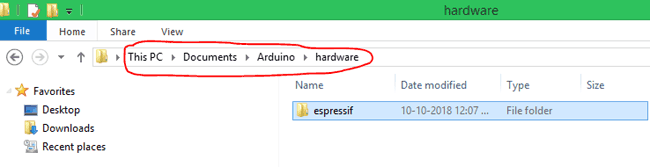
This step tin can exist skipped by users who are using ESP32 with Arduino for the first fourth dimension. For others who have already installed ESP32 board on Arduino using GIT have to delete the Espriff folder from Arduino Directory.
Windows users can notice this folder at Documents/Arduino/hardware, just notice the folder and delete information technology permanently earlier you proceed with other steps.
Preparing your Arduino IDE
Pace 1:At present, allow's become started. The first pace would exist todownload and install the Arduino IDE. This can be done hands past following the link https://www.arduino.cc/en/Main/Software and downloading the IDE for costless. If you already have one make certain it is of the latest version.
Stride 2: In one case installed, open the Arduino IDE and go to Files -> Preferences to open the preferences window and locate the "Additional Boards Director URLs:" equally shown below
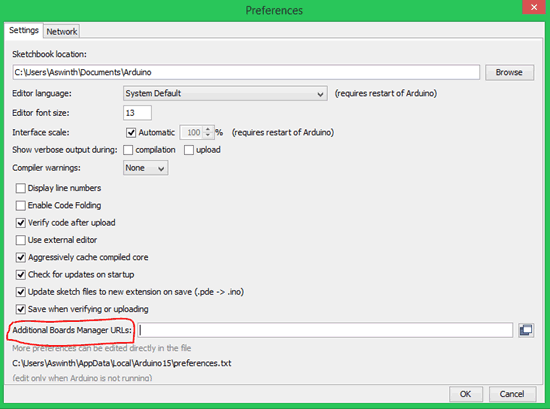
STEP three: This text box might be empty or might too contain some other URL if you take used information technology previously for ESP8266. If information technology is empty simply paste the below URL into the text box
https://dl.espressif.com/dl/package_esp32_index.json
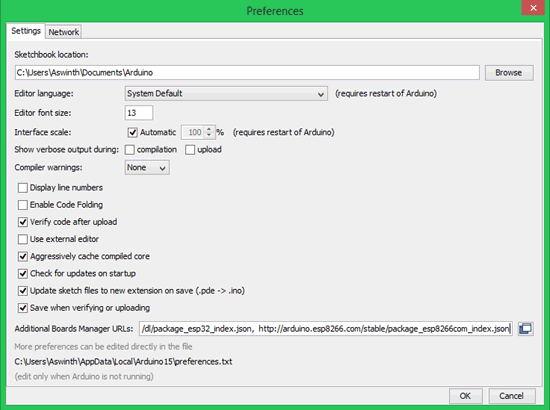
If the text box already contains another URL just add together this URL to it, separate both with a comma (,). Mine already had the ESP8266 URL I merely added this URL to and added a comma, like this
https://dl.espressif.com/dl/package_esp32_index.json, http://arduino.esp8266.com/stable/package_esp8266com_index.json
In one case done, my preferences windows looked similar this below. Just click on OK and the window will disappear.
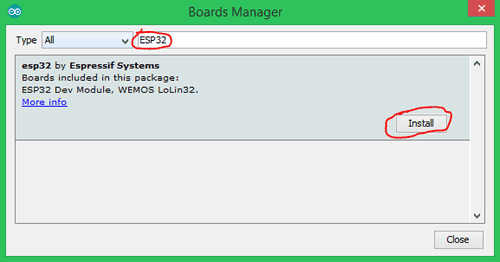
Step 4: Now get to Tools -> Boards -> Lath Managers to open the Board manager window and search for ESP32. If the URL was pasted correctly your window should find the below screen with Install button, just click on the Install push and your board should get installed.
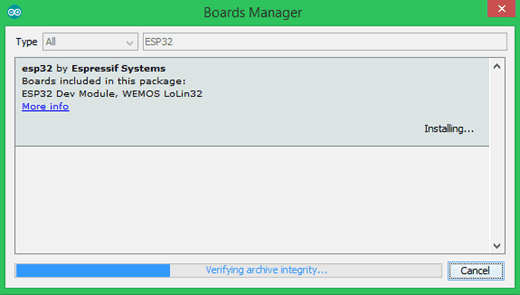
Step v: Make sure you have an active cyberspace connection and look while the installation gets complete. Information technology may take few minutes based on the speed of your internet connection.
That is it now ourArduino IDE is prepared to work with ESP32. Let'south become ahead and bank check if information technology is working.
Programming ESP32 with Arduino IDE:
STEP 1: Connect your ESP32 board to your computer through the micro-USB cable. Make certain the carmine LED goes high on the module to ensure power supply.
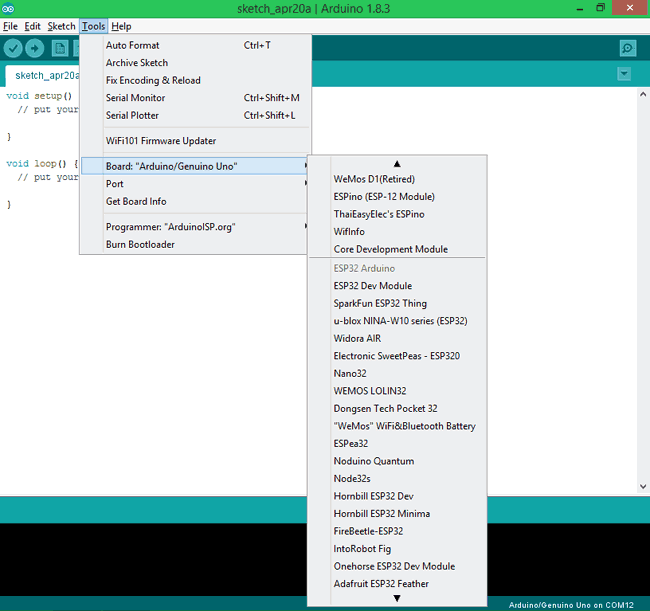
Footstep 2: Starting time the Arduino IDE and navigate to Tools -> Boards and select ESP32Dev lath every bit shown below
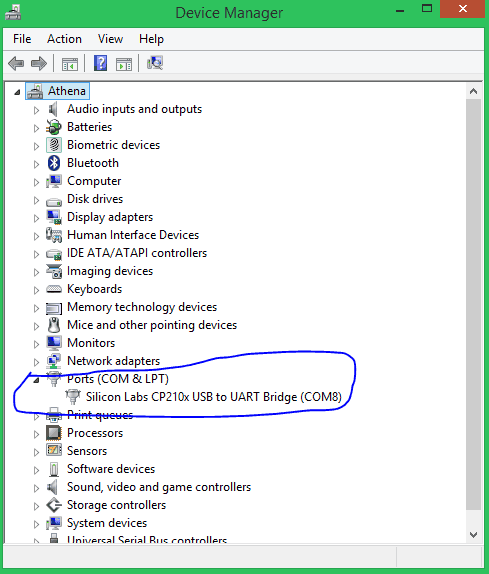
STEP three: Open up device manager and bank check to which com port your ESP32 is continued to. Mine is connected to COM 8 equally shown beneath
Step 4: Go back to Arduino IDE and nether Tools -> Port select the Port to which your ESP is connected to. One time selected yous should see something like this on the bottom left corner of the IDE.
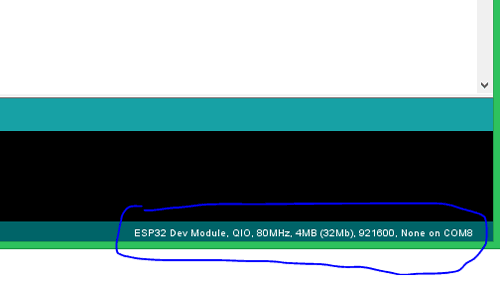
STEP 5: Allow's upload the Blink Programme, to check if we are able to program our ESP32 module. This programme should blink the LED at an interval of 1 2nd.
int LED_BUILTIN = 2; void setup() { pinMode (LED_BUILTIN, OUTPUT); } void loop() { digitalWrite(LED_BUILTIN, HIGH); delay(1000); digitalWrite(LED_BUILTIN, Depression); delay(g); } The programme is very similar to the Arduino blink code hence I am not explain them in detail. But ane alter is that, here in ESP32 the LED on board is continued to pin number ii, while for Arduino it volition exist continued to pivot number 13.
Pace 6: To upload the code, just click on upload and you should see the Arduino console displaying the following if everything works every bit expected.
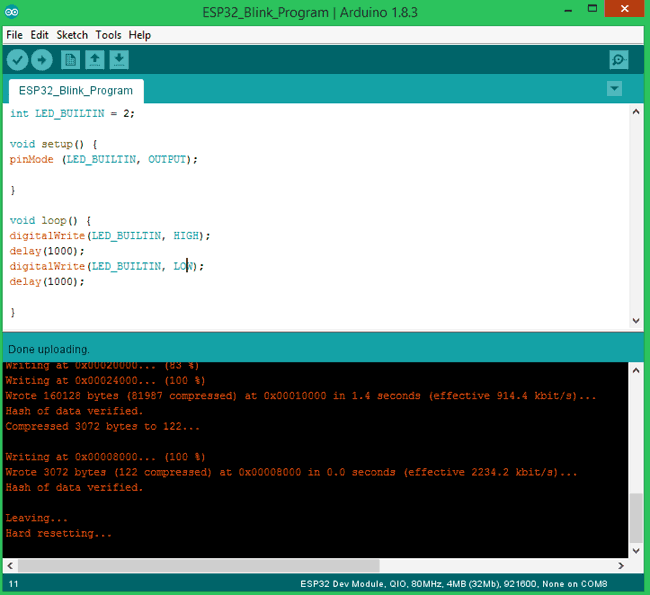
Note: For some modules, you might have to hold the Boot button during uploading to avoid mistake.
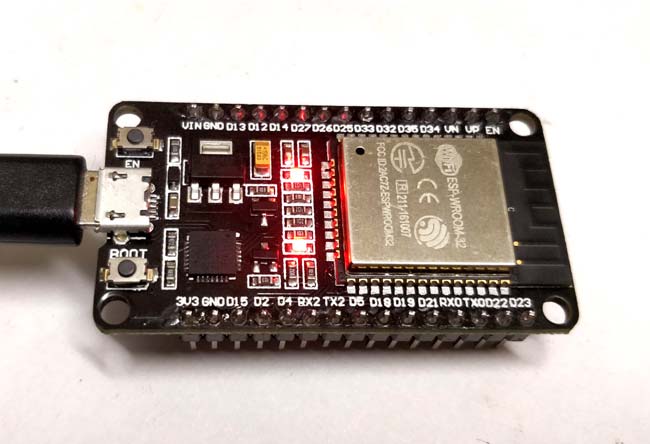
That is information technology we take successfully uploaded out outset code to our ESP32 board. My module with its LED blinking is shown beneath
This is how Programming ESP32 using Arduino IDE can be implemented. You can go ahead and effort the other example programs which are available at File -> Example -> ESP32 to work with other functionalities of the ESP32. If yous have had whatsoever trouble in getting this work, feel complimentary to post the query on the comment sections below. Y'all can likewise apply the Forum for getting technical assistance.
Lawmaking
int LED_BUILTIN = 2;
void setup() {
pinMode (LED_BUILTIN, OUTPUT);
}
void loop() {
digitalWrite(LED_BUILTIN, HIGH);
filibuster(chiliad);
digitalWrite(LED_BUILTIN, Low);
filibuster(1000);
}
gellertgonstornes.blogspot.com
Source: https://circuitdigest.com/microcontroller-projects/programming-esp32-with-arduino-ide
0 Response to "What Programmer Should I Use to Upload Sketch to Esp32 in Arduino Ide"
Post a Comment