A Person Elected to Roman Consul Served a Term of One Year and Could Not Run Again for
A consul held the highest elected political part of the Roman Republic (c. 509 BC to 27 BC), and ancient Romans considered the consulship the 2d-highest level of the cursus honorum (an ascending sequence of public offices to which politicians aspired) after that of the conscience. Each twelvemonth, the Centuriate Associates elected ii consuls to serve jointly for a one-year term. The consuls alternated in holding fasces – taking turns leading – each month when both were in Rome and a consul'due south imperium extended over Rome and all its provinces.
There were ii consuls in guild to create a check on the ability of whatsoever individual citizen in accord with the republican belief that the powers of the former kings of Rome should be spread out into multiple offices. To that end, each consul could veto the actions of the other consul.
After the establishment of the Empire (27 BC), the consuls became mere symbolic representatives of Rome's republican heritage and held very little power and dominance, with the Emperor acting as the supreme authority.
History [edit]
Under the Republic [edit]
According to Roman tradition, after the expulsion of the last king, Tarquin Superbus, the powers and authority of the king were given to the newly instituted consulship. Originally, consuls were chosen praetors ("leader"), referring to their duties as the main military commanders. Past at least 300 BC the championship of Consul became commonly used.[i] Ancient writers usually derive the title consul from the Latin verb consulere, "to take counsel", but this is virtually likely a later gloss of the term,[2] which probably derives—in view of the joint nature of the office—from con- and sal-, "get together" or from con- and sell-/sedl-, "sit downward together with" or "next to".[3] In Greek, the championship was originally rendered equally στρατηγὸς ὕπατος , strategos hypatos ("the supreme general"), and after simply as ὕπατος (hypatos).[two]
The consulship was believed by the Romans to engagement back to the traditional establishment of the Republic in 509 BC, simply the succession of consuls was non continuous in the 5th century BC, when the consulship was supposedly replaced with a board of consular tribunes, who was elected whenever the armed forces needs of the country were pregnant enough to warrant the election of more than the two usual consuls.[4] These remained in identify until the function was abolished in 367 BC and the consulship was reintroduced.[5]
Consuls had extensive powers in peacetime (administrative, legislative, and judicial), and in wartime often held the highest military machine command. Boosted religious duties included certain rites which, as a sign of their formal importance, could only exist carried out by the highest state officials. Consuls too read auguries, an essential religious ritual before leading armies into the field.
2 consuls were elected each year, serving together, each with veto ability over the other's actions, a normal principle for magistracies. They were elected by the comitia centuriata, which had an aloof bias in its voting structure which but increased over the years from its foundation.[ citation needed ] [ dubious ] However, they formally causeless powers only afterwards the ratification of their election in the older comitia curiata, which granted the consuls their imperium by enacting a law, the "lex curiata de imperio".
If a consul died during his term (not uncommon when consuls were in the forefront of battle) or was removed from office, another would be elected by the comitia centuriata to serve the remainder of the term every bit consul suffectus ("suffect consul"). A consul elected to kickoff the year—chosen a delegate ordinarius ("ordinary consul")—held more prestige than a suffect consul, partly considering the year would exist named for ordinary consuls (see consular dating).
Co-ordinate to tradition, the consulship was initially reserved for patricians and only in 367 BC did plebeians win the right to stand for this supreme office, when the rogatio Licinia Sextia provided that at least one consul each year should be plebeian. The first plebeian consul, Lucius Sextius, was elected the following year. Nevertheless, the office remained largely in the hands of a few families as, according to Gelzer[ who? ], only fifteen novi homines - "new men" with no consular background - were elected to the consulship until the election of Cicero in 63 BC.[6] Modern historians have questioned the traditional account of plebeian emancipation during the early Democracy (see Conflict of the Orders), noting for example that about thirty percent of the consuls prior to Sextius had plebeian, not patrician, names. Information technology is possible that only the chronology has been distorted, but it seems that one of the first consuls, Lucius Junius Brutus, came from a plebeian family.[vii] Another possible explanation is that during the 5th-century social struggles, the function of consul was gradually monopolized by a patrician elite.[8]
During times of war, the chief qualification for consul was armed forces skill and reputation, but at all times the option was politically charged. With the passage of fourth dimension, the consulship became the normal endpoint of the cursus honorum, the sequence of offices pursued by the ambitious Roman who chose to pursue political ability and influence. When Lucius Cornelius Sulla regulated the cursus by police force, the minimum age of election to consul became, in effect, 42 years of age.[9]
Beginning in the tardily Republic, after finishing a consular yr, a sometime delegate would usually serve a lucrative term as a proconsul, the Roman Governor of one of the (senatorial) provinces.
It would not be uncommon for the patrician consuls of the early democracy to intersperse public office with agronomical labor.[10] In Cicero'south words: in agris erant breadbasket senatores, id est senes:[11] 'In those days senators—that is, seniors—would alive on their farms'. This do was obsolete by the 2nd century.
Nether the Empire [edit]


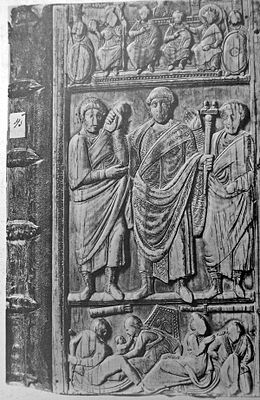
Although throughout the early on years of the Principate, the consuls were still formally elected by the Comitia Centuriata, they were de facto nominated by the princeps.[12] As the years progressed, the stardom between the Comitia Centuriata and the Comitia Tributa (which elected the lower magisterial positions) appears to have disappeared, and so for the purposes of the consular elections, there came to be but a single "associates of the people" which elected all the magisterial positions of the country, while the consuls continued to be nominated by the princeps.[13]
The purple consulate during the principate (until the tertiary century) was an important position, albeit as the method through which the Roman aristocracy could progress through to the higher levels of imperial administration – just former consuls could get consular legates, the proconsuls of Africa and Asia, or the urban prefect of Rome.[14] It was a post that would be occupied past a man halfway through his career, in his early thirties for a patrician, or in his early forties for virtually others.[12] Emperors frequently appointed themselves, or their protégés or relatives, consuls, even without regard to the age requirements. Cassius Dio states that Caligula intended to brand his horse Incitatus consul, just was assassinated before he could practise so.[15]
The need for a pool of men to fill the consular positions forced Augustus to remodel the suffect consulate, allowing more than the ii elected for the ordinary consulate.[12] During the reigns of the Julio-Claudians, the ordinary consuls who began the year usually relinquished their office mid-twelvemonth, with the election for the suffect consuls occurring at the same fourth dimension equally that for the ordinary consuls. During reigns of the Flavian and Antonine emperors, the ordinary consuls tended to resign subsequently a period of 4 months, and the elections were moved to 12 January of the twelvemonth in which they were to agree part. Election of the consuls were transferred to the Senate during the Flavian or Antonine periods, although through to the 3rd century, the people were however called on to ratify the Senate'due south selections.[16]
The proliferation of suffect consuls through this process, and the allocation of this office to homines novi tended, over time, to devalue the office.[14] Yet, the high regard placed upon the ordinary consulate remained intact, as it was 1 of the few offices that one could share with the emperor, and during this period it was filled more often than not by patricians or by individuals who had consular ancestors.[12] If they were peculiarly skilled or valued, they may even have accomplished a 2d (or rarely, a tertiary) consulate. Prior to achieving the consulate, these individuals already had a meaning career behind them, and would expect to continue serving the state, filling in the post upon which the country functioned.[17] Consequently, holding the ordinary consulship was a great accolade and the office was the major symbol of the still relatively republican constitution. Probably as part of seeking formal legitimacy, the break-abroad Gallic Empire had its own pairs of consuls during its being (260–274). The list of consuls for this state is incomplete, drawn from inscriptions and coins.
By the end of the 3rd century, much had changed. The loss of many pre-consular functions and the gradual inroad of the equites into the traditional senatorial administrative and armed services functions, meant that senatorial careers near vanished prior to their engagement every bit consuls.[17] This had the issue of seeing a suffect consulship granted at an before age, to the point that by the fourth century, information technology was being held by men in their early on twenties, and possibly younger, without the significant political careers behind them that was normal previously.[17] As fourth dimension progressed, second consulates, usually ordinary, became far more common than had been the example during the first two centuries, while the first consulship was commonly a suffect consulate. Also, the consulate during this period was no longer just the province of senators – the automated awarding of a suffect consulship to the equestrian praetorian prefects (who were given the ornamenta consularia upon achieving their office) immune them to style themselves cos. 2 when they were later granted an ordinary consulship by the emperor.[17] All this had the event of further devaluing the office of consul, to the point that by the final years of the 3rd century, property an ordinary consulate was occasionally left out of the cursus inscriptions, while suffect consulships were inappreciably always recorded by the first decades of the 4th century.[17]
1 of the reforms of Constantine I (r. 306–337) was to assign i of the consuls to the city of Rome, and the other to Constantinople. Therefore, when the Roman Empire was divided into 2 halves on the death of Theodosius I (r. 379–395), the emperor of each half acquired the correct of appointing i of the consuls—although on occasion an emperor did allow his colleague to appoint both consuls for various reasons. The consulship, bereft of whatever existent ability, continued to be a great accolade, merely the celebrations attending it – above all the chariot races – had come up to involve considerable expense, which merely a few citizens could afford, to the extent that part of the expense had to be covered by the land.[18] In the 6th century, the consulship was increasingly sparsely given, until it was allowed to lapse nether Justinian I (r. 527–565): the western consulship lapsed in 534, with Decius Paulinus the last holder, and the consulship of the Eastward in 541, with Anicius Faustus Albinus Basilius. Consular dating had already been abolished in 537, when Justinian introduced dating by the emperor's regnal year and the indiction.[xix] In the eastern court, the appointment to consulship became a part of the rite of proclamation of a new emperor from Justin Ii (r. 565–578) on, and is concluding attested in the proclamation of the hereafter Constans Ii (r. 641–668) as consul in 632.[20] In the late ninth century, Emperor Leo the Wise (r. 886–912) finally abolished consular dating with Novel 94. Past that time, the Greek titles for consul and ex-delegate, "hypatos" and "apo hypaton", had been transformed to relatively lowly honorary dignities.[21]
In the due west, the rank of consul was occasionally bestowed upon individuals past the Papacy. In 719, the title of Roman consul was offered by the Pope to Charles Martel, although he refused information technology.[22] Well-nigh 853, Alfred the Not bad, then a child aged four or v, was fabricated a Roman consul past the Pope.
Powers and responsibilities [edit]
Republican duties [edit]
Traditionally, after the expulsion of the kings, all the powers that had belonged to the kings were transferred to two offices: the consulship and the office of rex sacrorum. While the male monarch sacrorum inherited the kings' position as royal priest and various religious functions were handed off to the pontiffs, the consuls were given the remaining ceremonious and military responsibilities. To foreclose abuse of the kingly power, this authority was shared by two consuls, each of whom could veto the other's actions, with short annual terms.[23]
The consuls were invested with the executive power of the country and headed the government of the Republic. Initially, the consuls held vast executive and judicial ability. In the gradual evolution of the Roman legal system, however, some important functions were detached from the consulship and assigned to new officers. Thus, in 443 BC, the responsibleness to conduct the census was taken from the consuls and given to the censors. The second function taken from the consulship was their judicial power. Their position as main judges was transferred to the praetors in 366 BC. Later this time, the consul would merely serve as judges in extraordinary criminal cases and simply when called upon by decree of the Senate.
Civil sphere [edit]
For the near part, ability was divided between civil and armed forces spheres. As long as the consuls were in the pomerium (the city of Rome), they were at the head of government, and all the other magistrates, with the exception of the tribunes of the plebeians, were subordinate to them, but retained independence of office. The internal machinery of the Democracy was under the consuls' supervision. In order to allow the consuls greater authority in executing laws, the consuls had the right of summons and arrest, which was express only past the right of entreatment from their judgment. This power of penalisation fifty-fifty extended to inferior magistrates.
Every bit part of their executive functions, the consuls were responsible for conveying into effect the decrees of the Senate and the laws of the assemblies. Sometimes, in great emergencies, they might even act on their own dominance and responsibility. The consuls also served as the principal diplomat of the Roman country. Earlier any foreign ambassadors reached the Senate, they met with the consuls. The consul would innovate ambassadors to the Senate, and they lonely carried on the negotiations between the Senate and foreign states.
The consuls could convene the Senate, and presided over its meetings. Each consul served as president of the Senate for a month. They could also summon any of the 3 Roman assemblies (Curiate, Centuriate, and Tribal) and presided over them. Thus, the consuls conducted the elections and put legislative measures to the vote. When neither delegate was within the urban center, their civic duties were assumed by the praetor urbanus.
Each consul was accompanied in every public advent by twelve lictors, who displayed the magnificence of the office and served as his bodyguards. Each lictor held a fasces, a package of rods that independent an axe. The rods symbolized the ability of scourging, and the axe the power of death sentence[ citation needed ]. When inside the pomerium, the lictors removed the axes from the fasces to evidence that a citizen could not be executed without a trial. Upon inbound the Comitia Centuriata, the lictors would lower the fasces to evidence that the powers of the consuls derive from the people (populus romanus).
Military machine sphere [edit]
Outside the walls of Rome, the powers of the consuls were far more than extensive in their office as commanders-in-primary of all Roman legions. Information technology was in this part that the consuls were vested with full imperium. When legions were ordered by a decree of the Senate, the consuls conducted the levy in the Campus Martius. Upon entering the regular army, all soldiers had to take their oath of allegiance to the consuls. The consuls also oversaw the gathering of troops provided by Rome'due south allies.[24]
Within the metropolis a consul could punish and arrest a denizen, but had no power to inflict capital penalization. When on campaign, however, a delegate could inflict whatever punishment he saw fit on whatever soldier, officer, citizen, or ally.
Each delegate commanded an army, usually two legions strong, with the help of war machine tribunes and a quaestor who had financial duties. In the rare case that both consuls marched together, each 1 held the control for a day respectively. A typical consular army was most 20,000 men potent and consisted of two citizen and two centrolineal legions. In the early years of the Democracy, Rome's enemies were located in central Italy, so campaigns lasted a few months. As Rome'due south frontiers expanded, in the 2nd century BC, the campaigns became lengthier. Rome was a warlike society, and very seldom did non wage state of war.[25] And then the consul upon inbound role was expected by the Senate and the People to march his army against Rome's enemies, and expand the Roman frontiers. His soldiers expected to return to their homes afterward the campaign with spoils. If the consul won an overwhelming victory, he was hailed as imperator by his troops, and could request to be granted a triumph.
The consul could conduct the entrada every bit he saw fit, and had unlimited powers. However, after the campaign, he could be prosecuted for his misdeeds (for instance for abusing the provinces, or wasting public coin, as Scipio Africanus was accused by Cato in 205 BC).
Corruption prevention [edit]
Abuse of power by consuls was prevented with each consul given the power to veto his colleague. Therefore, except in the provinces as commanders-in-chief where each consul's ability was supreme, the consuls could merely act not confronting each other's determined will. Against the sentence of ane consul, an appeal could be brought earlier his colleague, which, if successful, would run across the judgement overturned. In lodge to avoid unnecessary conflicts, only one consul would really perform the role'southward duties every month and could human action without direct interference. In the next month, the consuls would switch roles with one another. This would continue until the end of the consular term.
Some other bespeak which acted every bit a check against consuls was the certainty that afterwards the end of their term they would be called to business relationship for their actions while in office.
At that place were also three other restrictions on consular power. Their term in role was brusk (ane year); their duties were pre-decided past the Senate; and they could not stand once more for election immediately afterward the end of their office. Commonly a flow of x years was expected between consulships.
Governorship [edit]
After leaving office, the consuls were assigned by the Senate to a province to administer as governor. The provinces to which each delegate was assigned were drawn past lot and determined earlier the finish of his consulship. Transferring his consular imperium to proconsular Imperium, the consul would become a proconsul and governor of one (or several) of Rome'south many provinces. Equally a proconsul, his imperium was limited to but a specified province and not the entire Republic. Any do of proconsular imperium in any other province was illegal. Also, a proconsul was non immune to get out his province earlier his term was complete or before the arrival of his successor. Exceptions were given only on special permission of the Senate. About terms as governor lasted between one and five years.
Appointment of the dictator [edit]
In times of crunch, when Rome's territory was in immediate danger, a dictator was appointed by the consuls for a flow of no more than six months, after the proposition of the Senate.[26] While the dictator held office, the imperium of the consuls was subordinate to the dictator.
Imperial duties [edit]
Afterward Augustus became the get-go Roman emperor in 27 BC with the establishment of the principate, the consuls lost most of their powers and responsibilities nether the Roman Empire. Though yet officially the highest office of the country, with the emperor's superior imperium they were merely a symbol of Rome's republican heritage. One of the two consular positions was often occupied by emperors themselves and eventually became reserved solely for the Emperor. However, the regal consuls still maintained the right to preside at meetings of the Senate, exercising this right at the pleasure of the Emperor[ citation needed ]. They partially administered justice in extraordinary cases, and presented games in the Circus Maximus and all public solemnities in honor of the Emperor at their own expense. After the expiration of their offices, the ex-consuls usually went on to govern 1 of the provinces that were administered by the Senate. They usually served proconsular terms of three to five years[ citation needed ].
Consular dating [edit]
Roman dates were customarily kept co-ordinate to the names of the ii consuls who took office that year, much like a regnal twelvemonth in a monarchy. For example, the year 59 BC in the modern calendar was called by the Romans "the consulship of Caesar and Bibulus", since the two colleagues in the consulship were Gaius Julius Caesar and Marcus Calpurnius Bibulus — although Caesar dominated the consulship and then thoroughly that twelvemonth that it was jokingly referred to equally "the consulship of Julius and Caesar".[27] The date the consuls took role varied: from 222 BC to 153 BC they took role fifteen March, and due to the Second Celtiberian State of war, from 153 BC onwards the consuls took part on i January.[28] The exercise of dating years ab urbe condita (from the supposed foundation date of Rome) was less frequently used.
In Latin, the ablative accented construction is often used to limited the date, such as "M. Messalla et Thousand. Pupio Pisone consulibus", translated literally as "Marcus Messalla and Marcus Pupius Piso existence the consuls", which appears in Caesar's De Bello Gallico.
Consular Dating Central
- 509–479 BC: 1 September–29 August (August had only 29 days in Aboriginal Rome)
- 478–451 BC: 1 August–31 July
- 449–403 BC: 13 December–12 December
- 402–393 BC: 1 October–29 September (September had 29 days)
- 392–329 BC: 1 July–29 June (29 days)
- 222–154 BC: 15 March–14 March
- 153–46 BC: 1 January–29 Dec (29 days)[29]
Epigraphy [edit]

An antoninianus commemorating the third consulate ("COS 3") of the emperor Philip (248 AD).
The word consul is abbreviated equally COS. [30] The disappearance of the Northward is explained by the fact that in Classical Latin an N before a fricative is pronounced as a nasalization of the previous vowel (meaning consul is pronounced /kõːsul/).
Besides, consul is pronounced [ko:sul], as shown in aboriginal writing, "COSOL", whereas the classical spelling (consul) seems similar an etymological reminder of the nasal consonant.[31] If a senator held the consulship twice and then: COS becomes COS II; thrice becomes COS III, etc.
Lists of Roman consuls [edit]
For a complete listing of Roman consuls, run across:
- Listing of Roman consuls
- List of undated Roman consuls
- List of consuls designate
Run across besides [edit]
 | Wait upwardly consul in Wiktionary, the free lexicon. |
- Constitution of the Roman Republic – Norms, customs, and written laws, which guided the government of the Roman Democracy
- French Consulate – Government of Revolutionary France from 1799 to 1804
References [edit]
- ^ Lintott, Andrew (2004). The Constitution of the Roman Republic. Oxford University Press. p. 104. ISBN0198150687.
- ^ a b Kübler, B. (1900). "Consul". Realencyclopädie der Classischen Altertumswissenschaft. Band IV, Halbband 7, Claudius mons-Cornificius. pp. 1112–1138.
- ^ Gizewski, Christian (2013). "Consul(es)". Brill's New Pauly. Brill Online. Archived from the original on 10 November 2013. Retrieved 2 July 2013.
- ^ Forsythe, Gary (2005). A Critical History of Early Rome: From Prehistory to the First Punic State of war . University of California Press. p. 236. ISBN0520226518.
- ^ Forsythe, Gary (2005). A Disquisitional History of Early Rome: From Prehistory to the Offset Punic War . Academy of California Press. p. 237. ISBN0520226518.
- ^ Wirszubzki, Ch. Libertas equally a Political Thought at Rome during the Late Commonwealth and Early on Principate. Reprint. Cambridge University Printing, 1960, p. xv.
- ^ Oxford Classical Dictionary, 3rd ed., Hornblower, S. and Spawforth, A. edd., due south.v. Iunius Brutus, Lucius
- ^ T. J. Cornell, The Beginnings of Rome, chapter 10.four.
- ^ Telford, L. (2014). Sulla: A Dictator Reconsidered. United Kingdom: Pen & Sword Military, pg. 216
- ^ Jehne, M. (2011) 'The ascension of the consular as a social type in the third and second centuries BC' in Becket al. (eds.) Consuls and Res Publica (Cambridge) 212
- ^ Cic. Sen. 56
- ^ a b c d Bagnall et al. 1987, p. one. sfn mistake: no target: CITEREFBagnallCameronSchwartzWorp1987 (help)
- ^ Bury, John B, A History of the Roman Empire from its Foundation to the Death of Marcus Aurelius (1893), pg. 29
- ^ a b Bagnall et al. 1987, pp. i–2. sfn mistake: no target: CITEREFBagnallCameronSchwartzWorp1987 (assist)
- ^ Cassius Dio, Roman History, 59:14:7
- ^ Michael Gagarin, Elaine Fantham; The Oxford Encyclopedia of Ancient Greece and Rome, Volume 1 (2010), pgs. 296-297
- ^ a b c d e Bagnall et al. 1987, p. 2. sfn error: no target: CITEREFBagnallCameronSchwartzWorp1987 (help)
- ^ Kazhdan, Alexander, ed. (1991), Oxford Dictionary of Byzantium, Oxford University Press, p. 527, ISBN978-0-19-504652-vi
- ^ Kazhdan, Alexander, ed. (1991), Oxford Dictionary of Byzantium, Oxford Academy Press, pp. 526–527, ISBN978-0-19-504652-6
- ^ Kazhdan, Alexander, ed. (1991), Oxford Lexicon of Byzantium, Oxford Academy Press, p. 526, ISBN978-0-19-504652-6
- ^ Kazhdan, Alexander, ed. (1991), Oxford Dictionary of Byzantium, Oxford University Press, pp. 526, 963–964, ISBN978-0-19-504652-6
- ^ e. The Frankish Kingdom. 2001. The Encyclopedia of World History Archived 2009-03-06 at the Wayback Machine
- ^ Derow 2012, p. 368.
- ^ Polybius - Histories book VI
- ^ State of war and guild in the Roman World ed. Rich & Shipley
- ^ Arthur Keaveney, in Sulla, the Final Republican (Routledge, 1982, 2nd edition 2005), p. 162ff online, discusses the engagement of a dictator in regard to Sulla, in which instance exceptions were made.
- ^ Suetonius' Lives of the Caesars: Julius Caesar Affiliate 20.
- ^ E.J. Bickerman, Chronology of the Ancient Globe (Ithaca: Cornell University Printing, 1968), p. 64
- ^ Robert Maxwell Ogilvie, Commentary on Livy, books 1–5, Oxford, Clarendon Printing, 1965, pp. 404, 405.
- ^ (in French) Mireille Cébeillac-Gervasoni, Maria Letizia Caldelli, Fausto Zevi, Épigraphie latine. Ostie : cent inscriptions dans leur contexte, Armand Colin, 2006, ISBN ii-200-21774-9, p. 34.
- ^ (in French) Pierre Monteil, Éléments de phonétique et de morphologie du latin, Nathan, 1970, p. 75.
Bibliography [edit]
- Bagnall, Roger S; et al. (1987). Consuls of the later Roman Empire. Philological monographs of the American Philological Clan. Vol. 36. London: Scholar Press.
- Burgess, R. W. (1989). "Consuls and Consular Dating in the Later on Roman Empire". Phoenix (Review). 43 (2): 143–157. doi:ten.2307/1088213. JSTOR 1088213.
- Beck, Hans; Duplá, Antonio; Jehne, Martin; et al., eds. (2011). Consuls and Res Publica: Property Loftier Part in the Roman Republic. Cambridge Academy Press. ISBN978-1-139-49719-0.
- Derow, Peter Sidney (2012). "delegate". In Hornblower, Simon; Spawforth, Antony; Eidinow, Esther (eds.). The Oxford classical dictionary (4th ed.). Oxford: Oxford University Printing. pp. 368–7. ISBN978-0-19-954556-8. OCLC 959667246.
gellertgonstornes.blogspot.com
Source: https://en.wikipedia.org/wiki/Roman_consul
0 Response to "A Person Elected to Roman Consul Served a Term of One Year and Could Not Run Again for"
Post a Comment