Framed Down the Lane 13x13 Inches Art Print White Wash Frame
Shop Art & Mirrors at One Kings Lane
Too often, art hangs around the house instead of upward on our walls. For starters, framing art often seems pricey and overloaded with options—a blueish mat with a white wood frame or a blue frame with a white mat? Maybe no mat at all? And then putting a nail into the wall seems similar a serious enough act to merit some special thought. Before we know information technology, a dozen Sunday afternoons accept rolled by and our walls are notwithstanding blank.
To come up with a no-fail, fun guide for finally getting everything framed and hung, nosotros tapped two of the leading companies in these specific arenas. Nosotros spoke with Tessa Wolf, creative managing director of Framebridge, an online-only company that takes lots of the hurting out of framing, to become help on how to frame a diversity of pieces, from children's art to a large-format photograph. And so we got the ultimate art-installation demo from ILevel, a New York company that has, over three decades, honed the fine art of the hang. David Kassel, ILevel's founder, counted that its small squad hung 56,000 artworks in 2015 solitary, everywhere from museums to celebrities' living rooms to the apartments of busy families.
Hither, a simple approach to framing and hanging, along with a few expert words of wisdom to brand a brandish you'll admire.
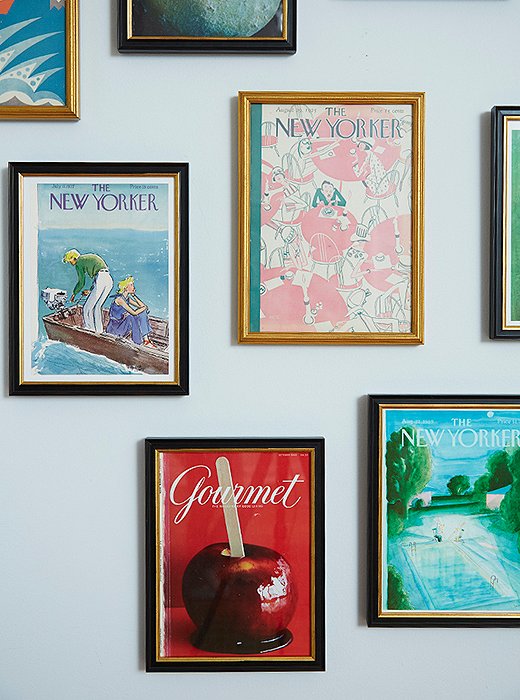
These Gourmet and New Yorker covers go new depth in Framebridge's Providence frame, with its black molding subtly lined in gold. Framebridge uses simply acrid-free materials for matting, and its acrylic is UV-protected to guard against lord's day damage.
Good-to-Know Basics
For total clarity, we are speaking here about artwork other than wildly expensive masterpieces or precious heirlooms—for those sorts of exceptions, have a skillful chat with a well-regarded framer to make sure y'all accommodate all special considerations.
i. Your home doesn't have to be a museum.The majority of the states collect wonderful artwork outside of the higher up categories: sentimental pieces we've inherited, flea market place and online scores, a photograph bought on a honeymoon, a few choice children'due south paintings, vintage posters, a cute quilt too frail for use but that could be dreamy on a wall. These are the pieces you want to frame well, without spending a fortune or feeling intimidated by the process.
2. Frame for the long booty.To preserve a piece over time, matting materials should be acid-free, and there should be a dust cover on its back. Traditionally at that place's a glass layer over the front, but some companies offer acrylic instead. Acrylic has the advantage of existence shatterproof and lightweight; on the other hand information technology can go scratched much more hands than glass. Any the fabric, the key is that it'due south been treated to protect from UV rays.
3. Care for canvas works differently from others.Oil paint on sail is generally hardier and more stable in the confront of the elements—hanging them in indirect sunlight is fine without any UV protection, and y'all can lightly dust them without worrying about doing damage. In fact, you desire to come across the textured sweeps and buildups of the paint. While you'd skip the glass and the mat for these, y'all might still want to surroundings the piece of work with molding (aka the frame itself).
4. Hang in the sun or in the shade?For sensitive mediums similar watercolors or textiles, UV protection on the glass won't be enough; these pieces should pretty much stay permanently in a well-shaded spot. Hang watercolors in a dim hallway or a night bedroom so that their brilliant colors won't get washed out by sunlight.
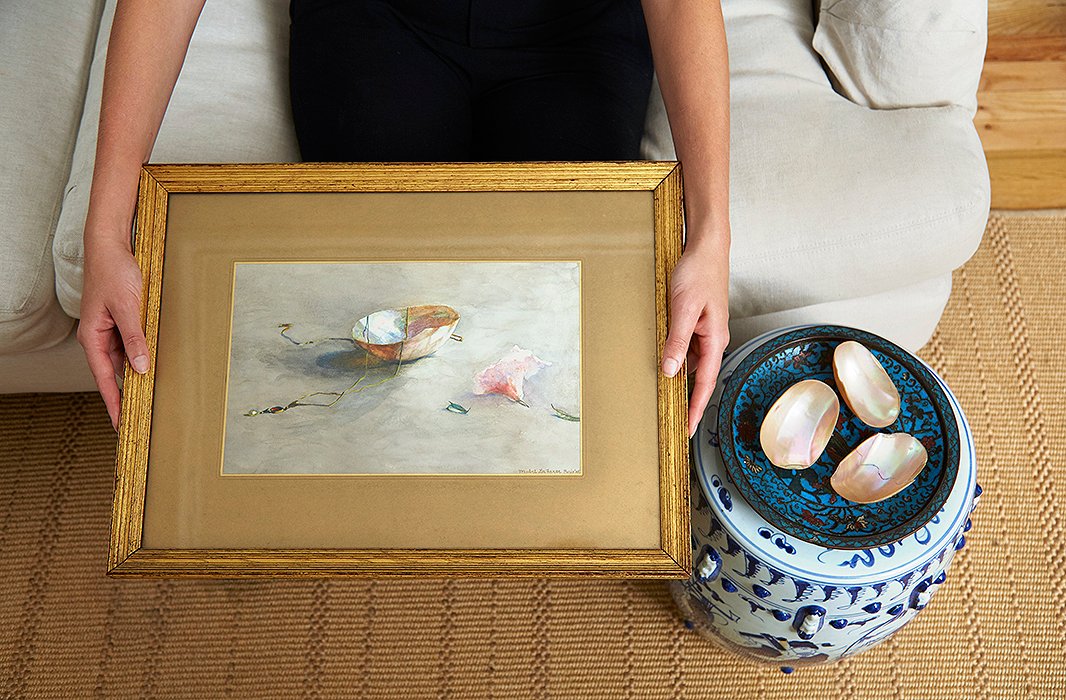
An inspiring thought: a watercolor from the turn-of-the-20th-century in a gold frame with gold matting (a golden mat and then a lighter gold-tan accent mat). Some might encounter information technology equally gilding the lily; others might similar the way the gold creates a jewel-box event effectually the notwithstanding life.
The Essential Matters of Matting
Frame shops will always enquire you whether you'd like something matted. A mat (which the English language phone call a mount) is a thin piece of paperlike material on which your art sits. It's mostly decorative, a backdrop to requite the artwork its moment in the sun. With a regular mat, the framer will cut a beveled pigsty in the middle of the decorative mat, and then identify the artwork on tiptop of a foam mat, which sits behind the decorative one.
1. To mat or not to mat?If you have any work on newspaper—a cartoon, a print, a watercolor—it's probable to look fifty-fifty lovelier with a mat. "Most pieces look better with a mat, with a couple of exceptions," says Tessa Wolf of Framebridge. "Large-format photography looks incredible unmatted—the image has a greater touch on without anything qualifying what y'all're seeing. For multiple pieces—like diptychs and triptychs—that are meant to be read equally one piece, information technology volition be a tighter, more cohesive story without a mat."
two. What about the mat color?The whole thought of matting is to place even more focus on the art itself, so when it comes to choosing color, exercise restraint. An understated white or fair will look fantabulous with well-nigh annihilation. If you want some drama or the piece is almost uniformly white, consider a gray or black mat to prepare it off.
If you'd like, yous can add an accent mat—a 2nd mat that sits within the primary mat and creates a sparse outline around the artwork. This accent mat isn't necessary; it can be gilding the lily. Only if yous become for information technology, call up of choosing a color that's plant in the work itself—a fleck of blood-red you desire to highlight, for example, or a gray undertone from the sky.
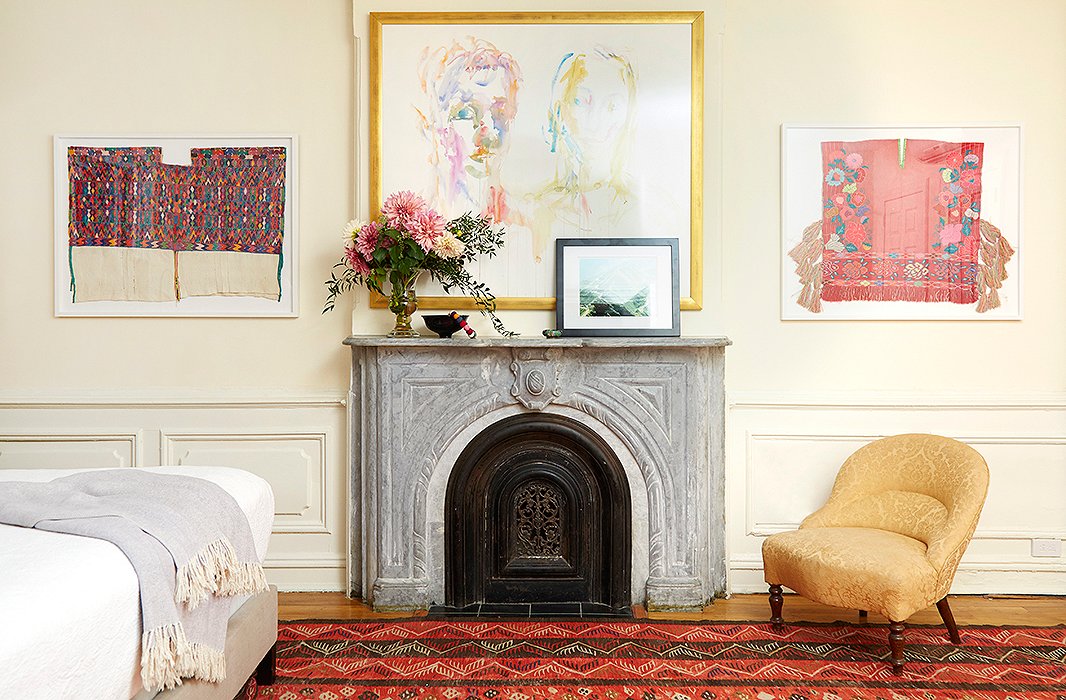
A multifariousness of moldings (frames) gives a room texture.

A Mexican textile floating (actually, sewn) on a mat to highlight its textured tassels and embroidery. Frame by Framebridge.
iii. Make your molding a match.The molding is the frame itself; when y'all walk into a frame shop, you're often confronted with hundreds of options. Again, do restraint: "Really anything volition look beautiful in a make clean white gallery frame—information technology's foolproof," Tessa says. That said, "whatever you choose, you always let the art atomic number 82." Paintings that are primarily green oftentimes look particularly glowing in a gilt frame, a celebrated favorite of framers. If yous go wilder, make sure it complements your piece—a carmine-lacquer frame might work with something in a Pop Art flavor, while a gold bamboo frame tin can look just correct with photography from the 1960s and '70s, such as a Slim Aarons work.
4. When to float 'em.For sure works, a float matting technique can vault the work into seriously special territory. Rather than placing the artwork behind the mat, this technique makes the artwork seem to bladder slightly to a higher place the mat. The mat is placed on the bottom, then a smaller piece of cream mat is mounted to the mat, and and then the artwork sits on top of the foam mat, perhaps 3/xvi of an inch above the decorative mat. With float matting, hidden spacers are placed underneath the lip of the molding, separating the acrylic from the mat "to give more of an impression of drama and space," Tessa says.
Cost note:Float matting ordinarily costs extra. It's worth considering for original artwork—amid other things, you lot'll be able to see the artist'southward signature well this fashion. Information technology'southward as well perfect for a piece that has a cool edge or texture to it or a piece "whose age you want to celebrate," notes Tessa—antique paper can be a beauty to behold in itself.
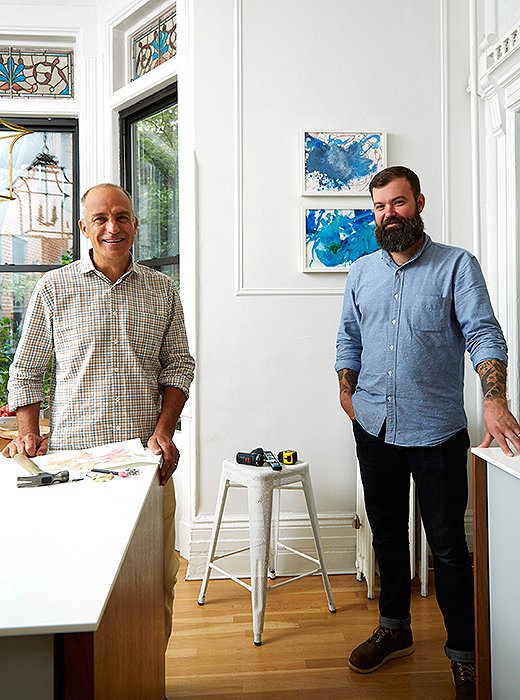
David Kassel and Chris Deo of ILevel, fresh off hanging the pair of toddler paintings behind them.
Hanging 101: The Key Principles
ILevel's David Kassel and Chris Deo are often called into a home only in one case the pigment has dried on the walls, the effects are set, and the rugs take been laid down. Yet many times, the addition of art turns out to exist the almost transformative stride of all. Their displays allow the art lead while staying in bear upon with the rest of the room and the surrounding architecture. Here, their all-time advice on how to make the most of each display—and how to hang art similar a pro.
1. Plot out your brandish.Earlier picking up a hammer, plot out what's going to go where (and for further inspiration on decorating with art, come across this slice).
two. Trust your instincts."I'd say 90% of the time, we merely become past what looks practiced," David says. This is particularly true when hanging art in any infinite affected by furnishings and architectural elements such equally mantels or archways. For these, have someone hold the piece while you look at information technology from seated and continuing positions. It'due south common to hang art too loftier, which makes a slice look as if it's floating around on its lonesome. When it doubt, hang low, so that the artwork relates more than closely to the article of furniture or the compages.
three. Utilise a measuring tape. This is essential, especially when hanging in what David calls "gallerylike spaces"—hallways, stairways, alcoves, or anywhere else not dominated by furniture or stiff architectural elements. For these areas, hang pieces so that the lesser is 58″–sixty″ from the floor. If you're hanging one artwork on summit of the other in such a space, brand 58″–sixty" the midpoint betwixt the two; then give two inches of separation betwixt the edges of the frames.
4. Cover irregularity.David and Chris don't talk much about gallery-wall-style hangings; instead, an art grouping might period similar a cloud or loosely from a top-heavy triangle, or it might fall into a gridlike pattern. Lay out your art on the floor beneath the wall kickoff and play around. To interpret the pieces to the wall, measure the total height and width of each, and so marker off those outermost points on the wall using painter's tape. From there, start hanging. Retrieve, imperfection is more than okay; fifty-fifty if the gold number for spacing between works is two inches, there's no need to be too rigid.
5. Don't line everything up. "Ofttimes people are tempted to line a slice up with the middle of a molding or the meridian of a nearby mantel or sofa," David says. This ends up feeling monotonous—instead, they accept pains to give each artwork its ain horizon line, keeping the entire room dynamic.
vi. Use the images to create focus. Some images take an ability to direct attention, fifty-fifty create a mood. For example, if you're hanging a group of works that includes a side-facing portrait, position the portrait so that information technology's looking into the group, rather than abroad from information technology. Or if the same portrait is most a window, position it to the side of the window where it volition be facing into the room, not gazing out the window. Similarly, darker pieces bear more visual weight, so ILevel positions them higher in a group so that all the focus doesn't clump at the lesser.
7. Exit some blank walls."This will happen by default," David says—once you've hung your favorite pieces in the places that make the nigh sense, you'll be left with some blank walls. Let them be. The consequence of the art that's there will exist fifty-fifty more than potent and lovely with some negative space.
viii. If you lot brand a fault, don't panic. "Whatever holes in the wall from a moving picture hook are purely cosmetic," David says. You'll likely cover them up one time yous hang the art properly; if non, "use some Spackle and the original paint if you accept it. Or fifty-fifty bit of toothpaste."
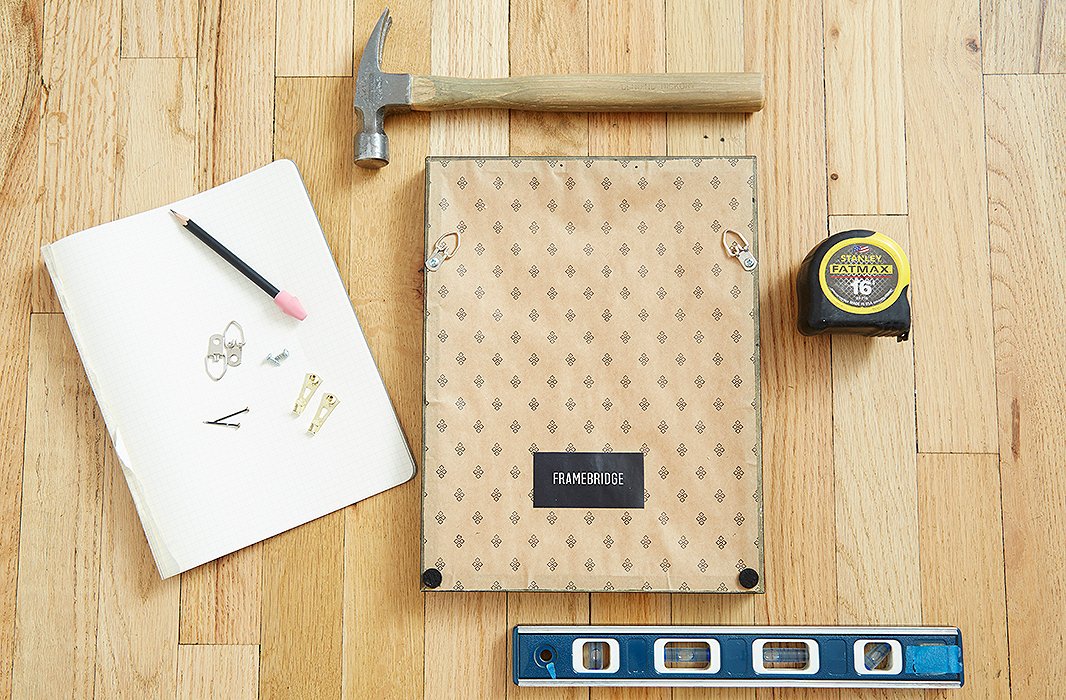
The necessary tools, according to ILevel, clockwise starting at the top: a hammer, a measuring record, a level (David recommends getting one that's at to the lowest degree 24″ for accuracy), gold picture hooks with their longer nails, D-rings with their short pinhead screws. And of course a pad to sketch out any designs or measurements.
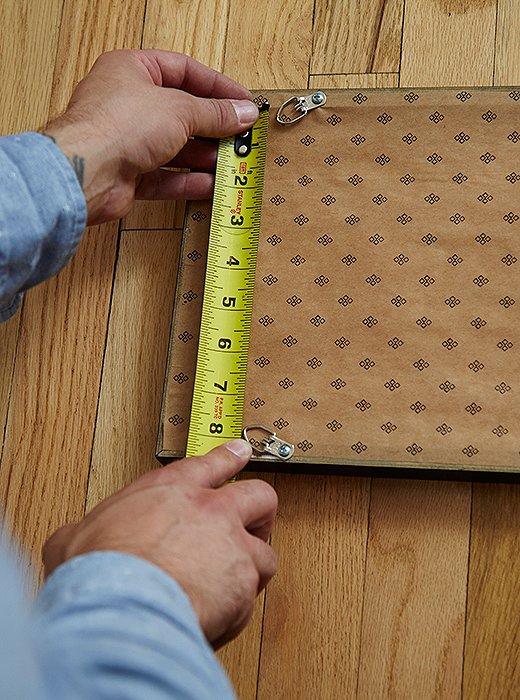
Measuring the distance between D-rings, in gild to detect the right distance to place the picture hooks on the wall.
The Right Tools: Put a D-Ring on It
For hanging hardware, David can't recommend D-rings enough. Rather than placing a hanging wire onto a pic claw in the wall, IFrame hangs D-rings directly onto moving picture hooks. They are and so rock-solid stable that you lot won't need to keep pushing the picture back into a directly line. And even if you brush by the fine art too aggressively, it barely moves. D-rings work for most anything, from small light pieces to very heavy works. Asking that the framer put D-rings on your art if possible.
If a piece comes outfitted with dissimilar hanging hardware—a sawtooth hanger or a hanging wire—ILevel will supersede information technology and quickly screw in some D-rings instead.
1. Get the correct supplies. At a hardware shop, you'll likely find OOK D-rings. Buy picture hooks and D-rings in equal numbers—2 of each for each work. If you already accept D-rings on there, only buy a picture show hooks for every D-band. Pay attending to the weight limit on all this hardware—Chris advises erring on the conservative side with the weight limits given for hardware: "If it says information technology holds 30 pounds, assume one-half that."
2. Do D-rings right. Along the back of the frame, measure out downwardly two to three inches from the top of the frame. Mark both sides—the important thing is that both are the exact aforementioned distance from the summit. Then spiral the rings in, and bending them to face inward slightly—this obscures the hardware and gives the picture even more stability.
3. Add hooks to wires.If you end up keeping a hanging wire on a painting, perhaps because it's an antique and the wire is yet strong, hang it with two moving-picture show hooks instead of 1 central 1. ("If you only hang on one hook, the piece will swing like its on a pendulum," David says.) Infinite them out to ii-thirds of the width of the frame.
4. Go hanging.Once you've decided the best spot for your artwork, hold it in place and make a tiny pencil dot at the heart of the frame's top. Put the fine art aside for a moment and measure downwards from that dot however far the D-rings are from the top of the frame. To discover where the two moving-picture show hooks will get (one for each D-band), measure out the total width between the D-rings and split that number—and then mark off that distance to the left and right of the centre. Blast the picture hooks into the spots, and claw on your D-rings. Voilà!
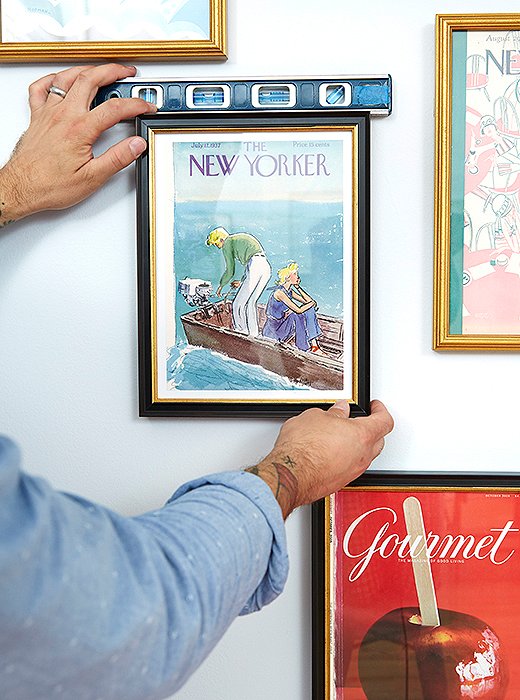
Using a level to cheque the straightness of a frame. Notice how some of these pieces are spaced ii inches apart, while others take more infinite betwixt them–charming irregularity at work.
Ever Even Out
Once a motion-picture show is hung, always middle a level on its top to see if information technology's straight. Only, David cautions, this is another area where center-balling it might be the most important function.
ane. Let your middle guide you."In New York, so many of the floors and walls are kleptomaniacal. Ofttimes if something were hung perfectly level, it would look crooked." And so they brand adjustments—tiny tilts once something is hung—to get it correct. If ane end of the piece is more than ane/iv″ too high, David suggests moving the location of the D-ring rather than the location of the picture claw. Information technology might seem counterintuitive, he says, but "if you want to lower one side, you raise that side's D-band."
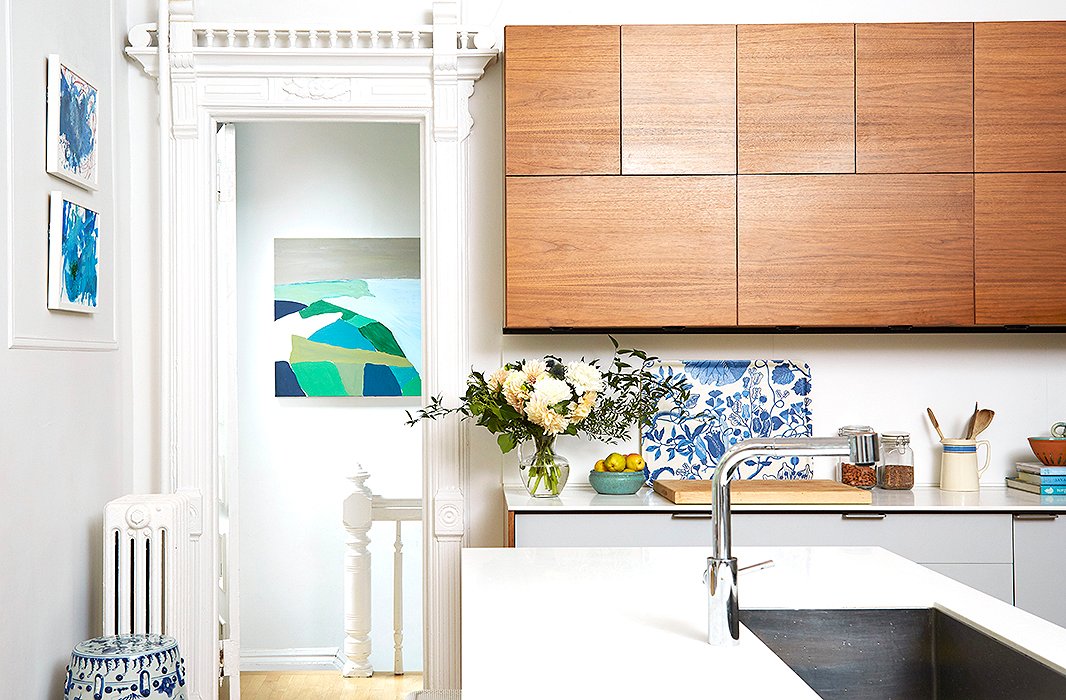
ILevel hung a large oil-on-canvas so that it almost fills the width of the doorway and commands attention from a distance. A child'south paintings hang in the kitchen, just above the wall molding—in this instance, the molding became the architectural indicate of reference.
Shop all art →
gellertgonstornes.blogspot.com
Source: https://www.onekingslane.com/live-love-home/how-to-hang-art-and-frame-art-expert-advice/
0 Response to "Framed Down the Lane 13x13 Inches Art Print White Wash Frame"
Post a Comment